Tales of Serge Ibaka’s demise are greatly exaggerated

After Toronto’s acquisition of Serge Ibaka last Tuesday, the reaction was generally positive. While many acknowledged the relatively low price of Terrence Ross and a mid-20’s first round pick, the trade was still not a slam dunk for one reason: Serge Ibaka is no longer elite. On Zach Lowe‘s podcast, he made it clear that Ibaka has been declining defensively for several years. For his part, Tom Haberstroh scoffed at the notion that he should care all too much about a trade surrounding a non-elite player.

Looking at Ibaka’s year to year stats, one can’t help but identify a clear peak. From 2012 to 2014, he amassed three First team all-defensive awards, achieved number 1 in blocks every year, and appeared in the NBA Finals once. In particular, His blocks per 100 possessions paints a worrying trend:

  • 2011: 6.9
  • 2012: 5.0
  • 2013: 4.1
  • 2014: 3.7
  • 2015: 2.9
  • 2016: 2.6

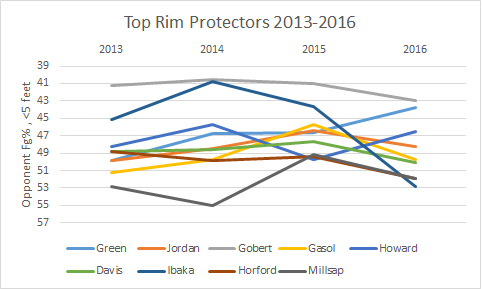
While this statistic is a very strong knock against the man known as “I-block-a,” blocks alone do not tell the whole story. As the power forward’s game has shifted towards the three point line on the offensive end, the league has been doing the same. Tasked with covering more perimeter oriented players, Ibaka has naturally had less opportunities for blocks. Therefore, it is more prudent to see how well players actually keep the ball of of the hoop when given the chance. Consider the following graph, featuring 9 of the best shot blockers in the past 4 years:

rim-protectors

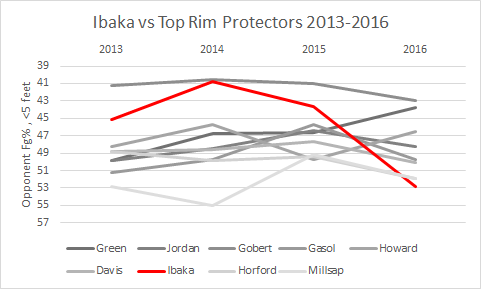
Using SportsVU stats from nba.com, players are compared using opponent field goal percentage within 5 feet of the rim on a shot that they contest. The axis is reversed, leaving the best rim protectors, also known as “Goberts,” at the top. If you select for only Ibaka, you can see that the decline of the past four years is greatly exaggerated:

ibaka-vs-rim-protectors

Second only to the “Stifle Tower” from 2013 to 2015, only this year has Ibaka seen a precipitous fall in his percentages. There are many factors at play here, the most significant of which being the complete change in teams, systems, and teammates. Rumours have come out in the past week detailing Ibaka’s inability to fit in with the Magic. After all, who can blame him for not trying even 90% on a team going nowhere?

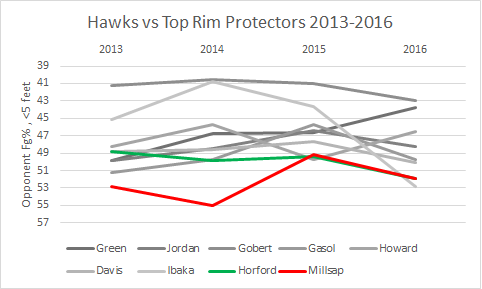
Interestingly, while the eye test may be saying that Ibaka’s calf injury in 2013 robbed him of his agility, it is possible that in 2014 he was once again the top of the class. The same cannot be said for two recent Raptor targets, Al Horford and Paul Millsap:

hawks-vs-rim-protectors

Having never reached the same defensive levels as Ibaka, these two former Hawks teammates are nevertheless applauded for “consistency” even while having a very similar season to the new Raptor’s “down” season. While there are other factors at play including ability to switch onto smaller players, there is nothing that suggests that they would have been better fits on the current Raptors lineup. Especially considering their ages of 30 and 31, there is no doubt that Ibaka can make at least an equivalent impact with the Raptors, if not greater.

All in all, the Raptor’s acquisition of Ibaka has to be seen as a huge win for the team. Not only do they acquire one of the league’s premier rim protectors, but they also did so at a fraction of the cost due to his perceived decline. I am confident that the Raptor’s gamble will pay off as Serge Ibaka is not just a great player, but an elite one still in his prime.


Demar Derozan: Elite SG*

For the past few years, Demar Derozan has been considered to be a near elite player, with many obvious limitations. Perimetre shooting. Defence. As much as those have been expanded upon, his upside has also been touted. Low turnovers. Free throws. At the end of the day, can you really consider him elite, though? He certainly he thinks he is, tweeting out frustration over his ranking of SI.com recently. Nobody, not even the most arduent of Raptors fans, would belive that Derozan can be a Number one on a title winning team, or really as it stands the number two. Not in a league with Lebron and Durant.

But there lies the rub, and watch out because it’s going to get philosophical: Durant is technically the second best small forward in the league, right? Sure, he might be a perrenial MVP candidate, but at his position, he’s still second best with Leonard and George nipping at his heels. Point Guard has always been deep, Centre is getting an athletic revival via the past 4 drafts, and even Power Forward has been reinvented with elite jack of all trades like Green and Millsap at the top.

Which brings me back to Derozan, and more interestingly, his position as it currently stands. Harden is a PG, George and Butler are SFs, and Wade is now in the twilight of his career. Who else, but players with only one full season pedigrees like McCollum, Beal, and Middleton. If you think about it, Only Klay Thompson is in the way of Derozan being the best Shooting Guard in the league, but he will definitely settle for second.

With the league transitioning towards position fluidity, how important really is that asterisk? Second Best Shooting Guard *. I would argue that it is still very significant achievement, and here’s why: Teams still line up with five players beginning games, one for each position. In a league where every advantage is significant, Derozan lines up with an advantage over everybody but the Golden Boys from Oakland. He can punish two point guard lineups with his post ups, or even teams with a defence specialist at SG for Kyle Lowry (Detroit, anyone?) Derozan’s no role player. He’s a star. And not only is this league driven by advantages, it’s driven by stars. So throw that ranking and the backhand compliments back, Derozan. Prove everyone wrong. Show them why Toronto is so lucky to have the second best Shooting Guard. No asterisk needed.


The NBA adjusts to the Raptors – and the Raptors still won

It is a great time to be a Raptor fan right now. Sure, there’s the defeatist mentality that still looms over like a dark cloud, with two consecutive years of first round exits fresh in everyone’s mind. Whatever optimism that exists can be placed onto the Raptor’s MVP, and indeed a candidate for “second best player after Steph Curry.” That man, of course, being the unstoppable Kyle Lowry. Most notable has been his work with the bench unit of Joseph, Ross, Patterson, and Biyombo.

<blockquote class=”twitter-tweet” data-lang=”en”><p lang=”und” dir=”ltr”><a href=”https://twitter.com/hashtag/TerrenceRoss?src=hash”>#TerrenceRoss</a&gt; <br>(h/t <a href=”https://twitter.com/DexterC73″>@DexterC73</a&gt; ) <a href=”https://t.co/ojXTlyOJRr”>pic.twitter.com/ojXTlyOJRr</a></p>&mdash; BBALLBREAKDOWN (@bballbreakdown) <a href=”https://twitter.com/bballbreakdown/status/702989589988798465″>February 25, 2016</a></blockquote>
//platform.twitter.com/widgets.js

The caveat, as it always is with bench units, is that it is coming against the opposition’s bench as well. The theory is that when the lineups get smaller come playoffs, that advantage will no longer be present. However, if you look at the past 5 games, you can see that the league is now adjusting by playing starters, and the Raptors are still coming out ahead. Let’s take a look at the past 5 games

February 26th, 2015 vs Cavaliers

Cavs Feb 26th

In the franchise-rocking game against the Cavaliers, the Lowry+Bench name was deployed for the second half of the third quarter. If you look up at the Cavalier’s roster during that time, who else do you see but the King himself. Even against Lebron and fellow starter Tristan Thompson, the Raptors held a 4 point advantage during that time span. Also notable is the time spent with Derozan instead of Ross at the beginning of the fourth quarter, when the Raptors were a +12.

The previous two games before that were similar. While the Timberwolves were more traditional by only playing starter Gorgui Dieng and managing to break even during those times, the Knicks adjusted by playing Carmelo. The last game to look at is against Memphis, which points strongly to how opposing coaches are adjusting to the Raptors.

Griz vs Raptors

At the beginning of the Second Quarter, when the Lowry+Bench unit was in, the Raptors were a collective +4. Dave Joeger obviously wasn’t happy with that, as to counteract them in the fourth quarter, he counteracted the move by playing his best player – Mike Conley – the entirety of the time. This isn’t normal behavior for him.

Griz vs Suns

This snapshot, from the most recent game against the Suns, demonstrates the Grizzlie’s preferred approach of resting Conley at the beginning of the 4th quarter. From this point on, there is no use in diminishing the stength of  Kyle Lowry with the bench. They are already proving their mettle against All-Stars.

Comparing Valanciunas and Brook Lopez

When Jonas Valanciunas was drafted back in 2011,  the Toronto Raptors were a team in disarray. A look at their roster for that year reveals a lineup without many players with promise. Jack vs Calderon was replaced by Bayless vs Calderon in a never-ending merry-go-around to find an above average point guard. Ed Davis, who many believed a steal at his draft position, never found his groove. Andrea Bargnani, the supposed 7 foot tall European savior, had the highest Usage percentage on the team.

In Valanciunas, the Raptors once again had a player that fans could dream on. With efficient post moves and rock-solid defence, many saw Valanciunas as a pillar to build around for the future. While Trade Machine deals for stars inevitably begins and ends with the inclusion of Valanciunas, the big man has quietly progressed into an above average starting centre at the age of 23. While solid, he has yet to make that leap into stardom many envisioned for him. Going through the list of top centres in the game, it is hard to find comparables for big Val to aspire towards. Duncan, Gasol, Horford are all at the top of the mountain, but have passing vision that it’s tough to project onto the young centre. Howard, Jordan, Drummond, Whiteside, and Gobert are all defensive-minded players who offensively offer not much more as a roll man, which doesn’t leave many overlapping skills.

Finally, there’s Brook Lopez. A seven footer who has the free throw shooting of a guard, does work on the offensive glass, and punishes anyone who concedes deep post position. His weaknesses include a simplistic grasp of passing, slow-footedness on defence, and hilariously enough, teammates that don’t fully utilize his post-up abilities (Less than a quarter of his shots are off post ups, even with above average efficiency). As Lopez will never be the alpha dog on a contender, as the state of the Nets currently attests to, he can be a solid second banana who in his prime is a fringe-All Star. While it’s not a terribly exciting goal for Valanciunas, with him being now in his fourth year, it can only be seen as a realistic expectation.

With that being said, there’s still many improvements that Jonas will have to make to his game in order to lift it up to the 20 ppg level that Brook Lopez currently resides in. Firstly, if you break their shooting up into distances, you can see a disparity in how they get their points.

LopezValanciunasDistance

Notably, Valanciunas does a third more of his damage right beside the basket when compared to Lopez. The further out you go, the more that you can see the disparity. Lopez is very comfortable in the mid-range game, shooting above 46 % for the 6-19 foot range. You can also see it more clearly in the type of shots that the two big men take. LopezValanciunasShotSelection

With everything else being relatively equal, it really comes down to Jump shots vs Layups. The types of shots that Valanciunas enjoys taking feel very safe. He gets it close to the basket, makes a move or two, and lays it in. As evidenced by his now infamous propensity to pump fake at invisible opponents, he doesn’t completely trust his jumper just yet. Which is a shame, considering that he has such a good stroke. I am a believer that any big man who makes his free throws like big V should be able to at least trust his pick and pop skills from the key. Valanciunas is no different, as he shoots a great 45% from the midrange.

Whether it falls on the coaches, the guards, or Valanciunas himself, there’s a clear opportunity for improvement that is not being taken. Offensively, the biggest hurdle right now into at least the conversation for All-Star selection is a dependable jump shot. My next article will touch on just how important that would be to this Raptors team in particular.


Operating from the Post

During the current era of pace and space, much has been made about the death of the post. Along with this shift has been a counter wave of analysts suggesting that there are still uses for the art of posting up. Coming from esteemed analysts Zach Lowe and Coach Nick, it is suggested that even if post scoring is down, passes from the post can still be cornerstones for efficient offences. With that being said, it is important to put the to the test: If teams shift towards more passing than scoring out of the post, do their offences become more efficient?

To start off, I decided to categorize offences based on their usage of post touches. stats.nba.com conveniently provides when a post touch ends with a pass or shot, so I compiled them into one stat, Fga/Pass, or the ratio of shots to passes. If Coach Nick’s hypothesis is correct, that passing out of the post is more efficient, then teams that elect to pass instead of shoot, and thus have a lower Fga/Pass percentage, should be more efficient.

Firstly, I examined whether teams would have better overall effective shooting percentages. Theoretically, if a pass should lead to a more efficient offence, then there should be a negative correlation.

efg vs FGAPass

While this graph does demonstrate the negative correlation I was expecting, the R squared value is much too small to be able to glean anything of significance from it.

Secondly, on a hunch, I decided to look at the correlation between post touch passing and turnovers. Intuitively speaking, players who can pass from the post, such as Tim Duncan, tend to create a smoother flowing offence than a post bully. What I would expect to find is that a scorer is more prone to turnovers, and thus a positive correlation between Fga/Pass and TOV%.

FGApass vs TOV%

While the slope of the trendline matches my hypothesis, the problem again is in the correlation coefficient being far too low. For both graphs, the problem is evident in how spread out the data is.

In conclusion, while my research proved inconclusive in determining whether passing out of the post led to an efficient offence, mostly due to a small sample size, there is definitely room for further research using multiple years worth of data.

Inch by Inch: a game of luck

We live in an era where analytics have taken over sport. With Moneyball providing the doctrine and manifesto, the upheaval of old school sports has been religiously carried out over the past decade. However, in the effort to quantify all aspects of sport, we as fans have become too devoted to the church of meritocracy: where talent will always win out in the end.

I’ve grown up in this new age of sport, and yet the emotional element of it has always left a deeper impression. I can remember as far back as grade 7, I was pretending to be Al Pacino for a speech contest, trying to invoke the same aura of strength and determination.


The term “inch by inch” not only resonated in me emotionally, but it also changed the entire paradigm through which I view sport. To this day, I can’t shake the belief that overall, the outcomes of games and even seasons can depend on inches. When a baseball just sneaks under a fielder’s glove, the baseball gods are cursed. When a basketball bounces around the hoop for seemingly forever before going in the net, the basketball gods are praised. The point is, whether we consciously recognize it or not, luck is a force that controls every sport with an impartial hand. Nevermind how skilled you are, nobody is immune to the powers of luck.

Watching the Tottenham vs Watford game today, my jubilation at seeing my Hotspurs claim third in the table was dampened by the knowledge that with the better luck of a couple inches, Watford could have emerged victorious.

To recap: Lamela scores the first goal by nutmegging the last defender on his shot. The second, Ighalo nutmegs Dier on his way to a short breakaway. Lastly, Son, NOT EVEN LOOKING, backheels a shot through the legs of the keeper. Three goals, three nutmegs through the inches of free space between the legs. One late chance at a 2-1 win by Watford, cleared off the line by Hugo Lloris. Goal line technology says….

That was the game. One more inch on that shot and the repercussions would be massive.  You might think that it’s just one game, but the difference between a win and a loss to a near competitor is huge. Instead of being 6 points up on the 1st year premier league team as they are now, Tottenham would be tied. Just look at how one game between City and Arsenal changed the title race drastically, courtesy of the football mastermind Michael Caley:

Inch by inch, Tottenham conquered its competitor on its way to glory. Not in the ways of Al Pacino, mind you. The inches were not gained by strength and determination. Rather, you can chalk it up to the soccer gods.

On luck and super teams

The idea of a super team is a curious phenomenon within basketball circles. If you’re a fan of said superteam, then all of their strengths will take them to glory. On the other hand, if you’re a fan of any other of the 29 teams, then their weaknesses will eventually doom them. Being a fan of the San Antonio Spurs, I’ve heard many variations of the same defence of their current super team. The general idea goes that because the Spurs lack the egos that prevailed in super teams such as the Dwight Howard era Lakers, then the team would benefit from the individual sacrifices made. While that romantic idea of playing basketball “the right way” may sound like an obvious advantage, the truth is that much of it depends on an emotionless, uncontrollable entity: luck. No plan is perfect in the NBA because even if you reveal a perfectly planned superteam, then your opponents can use your obvious plan against you. Sometimes, it takes tinkering and luck to find the perfect fit, and sometimes from unexpected places. As a fan of the Spurs, it will not be their humility that will give me hope, but their ability to adapt. After all, even the best laid plans need a sprinkle of luck.

The biggest problem with one perfect, all-powerful plan is its transparency. If you build your team with a gameplan in mind, then you will have 29 teams trying to peck away at that one explicit gameplan. For example, you can believe that a key benefit of Aldridge over Splitter is his ability to be the release valve on drives with shots from distance. However, with that knowledge widely known, where can you expect other smart defences to put up their longs arms on each drive? Directly in front of wherever Lamarcus is. Take the previous Finals for example. Everyone knew that if you trap Curry, you’re getting a Draymond Green led 4 on 3. The plan is that you surround an excellent passer with shooters on either side. Everyone and their mothers knew this plan, and the Cavs, for games 2 and 3 at least, played Draymond like a fiddle by staying home on the shooters making this amazing passer shoot. Bogut had to be taken off for more offensive firepower as a result, the first time all season that had to happen. The same thing, that other teams make adjustments, can happen to any team with a super plan.

Super teams win with the lucky discoveries that lead to them discovering versatility. Without injuries to Bogut and Lee, the Warriors may have never discovered the world-destroying ability of putting the 6 foot 7 Green at the centre position. This adjustment, which many may have not thought of when the season started, ended up saving their season. Another example is the recent Heat super team that stumbled head first into discovering their identity. Why did it take them so long to gel? Egos? No, it was the inability to discover how to best utilize probably three of the most athletic players in the entire association. Their solution, which came with much tinkering, morphed into the terrifying, high-flying, trapping and recovering machine that came to define their short run. While Bosh’s lateral quickness may have not been the most obvious advantage to having the big three, it became instrumental for their chase down defensive scheme that won them two titles. It is the adjustments that come from random tinkering and luck that helps superteams win championships.

With that being said, this year, it is the Spur’s ability to adjust that will give me faith for an extended playoff run. It won’t be those unicorn photos of Kawhi smiling with Aldridge or the steely David West standing up for his teammates against nasty opponents. Despite the allure of a well-oiled and drama free collective, their road to victory will be more nuanced. With Lamarcus as a potential hub, can they get past the biggest hurdle from last year: a lack of chaos inducing dribble penetration. If Duncan shows signs of wear against the big centres thrown his way, can their roster of power forwards find ways to help him? With Kawhi’s budding pullup game, Parker getting pushed away from the basket, and Aldridge in the fold, can you get past potentially starting three players looking for separation for mid-range shots? I don’t care if the Spurs stumble butt first into solutions, but these technical questions, and many others, will define the success of this admittedly highly versatile lineup.

As the saying goes, no team ever won the championship in July. Everyone needs a little help along the way. Teams need to accept the fact that plan A most likely will not go unopposed. Lucky discoveries can go along way in forging a team’s identity. For the Spurs, it will all about be about their ability to adjust that helps them to the title. For a sport that sometimes can come down to miracle shots with 0.4 seconds remaining, it’s amazing how many people believe in fate.

The Rudy Gay trade: Two seasons later.

The dream of every general manager in the league is the red paper clip scenario. Essentially, you are able to turn what seems to be a useless item, a paper clip, into tangible assets through shrewd trading.

When Masai Ujiri took over the Raptors’ two summers ago, he really got to work remaking the useless items Brian Colangelo had left behind. He somehow snatched a first rounder for draft pick for Andrea Bargnani. That draft pick looks better by the day as the Nuggets officially entered the rebuilding process with the trade of Ty Lawson. While that may sound amazing, I would contend that the Rudy Gay trade could potentially be even better.

Consider this: Raptors fans would have been ecstatic with peanuts in exchange for Gay. Seriously, the expirings of Rodney Stuckey and Charlie Villanueva were seriously considered. If that trade came to fruition, all benefits could have ended by last summer. Instead, Masai got the gift that kept on giving. Let’s go over the return, a textbook example of asset accumulation.

Patrick Patterson

Resigned last season to a team friendly contract that looks minuscule with the cap explosion, PatPat is now slotted as the starting power forward, in hindsight an excellent insurance policy for Amir Johnson’s ankles. There really is no need to wax poetic on what Patterson is: a useful starter.

John Salmons

  • Lou Williams
  • Lucas Nogueira

While John Salmon’s play was nothing to write home about, his contract ended up being extremely valuable. Lacking cap space to pursue a top free agent last summer, the Hawks ended up giving up two very nice pieces in exchange for the opportunity to ultimately sign…. Thabo Sefolosha. In exchange, the Raptors received a year of 6th-man of the year winning play from Lou Williams, whose stock was at an all time low when the Raptors acquired him. While his chucking ways were incredibly painful to watch (a trait carried over from his old team no doubt) , he was nevertheless the Raptors’ third most important player last year. All of this while staying healthy and weathering the storm as the top 2 options nursed their own injuries. If some hardware wasn’t enough compensation for John freaking Salmons, Masai also poached Nogueira, whose high leaping and smooth passing play this summer reignites hope that he can a solid rotational piece in the future.

Greivis Vasquez

  • Norman Powell
  • Clipper’s lottery protected first round pick in 2017

The Vasquez trade is great in isolation, and straight up terrific when viewed in the prism of this trade. He was held in impossibly low esteem by a Sacramento front office that goes through more quality point guards than Charles Barkley does fat jokes. Another buy low opportunity that Ujiri pounced upon. With two useful seasons ultimately tainted by allergies to defence that often coincided with the Spring, Vasquez was able to rehabilitate his value to the point that I’m not sure if the package for Ty Lawson is any better. However low, first round draft picks have incredible value in an era where continuity is very hard to accomplish. With the cap boom, the relative stability of the pay of draftees has reached maximum utility. In addition, the Raptors were able to parlay that second round draft pick, normally of little consequence, into an intriguing prospect in Norman Powell. Powell’s ceiling was and still is relatively low due to his age and lack of spacing, but Ujiri again bought low to secure what looks is hopefully another solid rotational piece. An excellent breakdown of his abilities can be found here. Basically, Powell can be useful on account of his defence even if his jumper never develops. Normal summer league caveats apply, but gaining First-Team honours is nothing to scoff at. If nothing else, Ujiri bought low on what looks to be the most likely so succeed out the 2015 second round.

Chuck Hayes.

A useful situational player brought in as a stretch 5. 

In the end, which deal would you rather take? Two expirings that had no impact going forward? Or would you rather have a solid starter on the cheap, one year of an award winning sixth man, 2 young prospects looking to crack the rotation, a first round draft pick right as its value peaks, and two years of a solid 6 foot 6 backup point guard and the 6 foot 6 version of Dirk? (I still can’t get over how Vasquez and Hayes are the same height). 

Granted, if Ujiri had stayed pat, the original return would have been uninspiring. However, by buying low on 3 separate occasions, Ujiri has been able to turn the untradeable Rudy Gay into a large stable of assets. As Bill Simmons would point out, this haul could have gotten you James Harden. At the end of the day, red paper clips are the name of the game.

The Five Giants of Westeros

With the acquisition of Ty Lawson yesterday for pennies on the dollar, the Rockets have now joined what I am calling the Five Giants of Westeros. * There are legitemate scenarios where I can imagine any of the Warriors, Spurs, Clippers, Rockets, or Thunder being the lucky team to defeat the Cavs in the finals. Think about it: As there are five teams, that means one of these title contenders will be going home in the first round like last year. It’s anyone’s guess who will finish at the top, but for now, let’s take a look at how they stack up against each other.

Point guard

  1. Clippers
  2. Warriors
  3. Thunder
  4. Rockets
  5. Spurs

I’ll get this out of the way first: I firmly believe that Steph Curry can be the MVP without being the best overall point guard. It is similar to how LeBron James is undoubtedly the best player while conceding the award. To me, it’s all about consistency. Don’t get me wrong here, I’m not hating on offences based on jump shooting like Charles Barkley. My point is that Chris Paul has been king of this hill for the past half decade. It takes adjustments to be able to survive at the top like that. Meanwhile, Curry just took the leap into stardom in this one Cinderella year. As much as it’s a copycat league, there are now teams building specifically to stop the Stephs and Lilliards of the world.

Paul, commonly known as the Point God, has generally been the same: Elite distribution, elite defence, and possesses the ability to take over a game scoring wise if need be. Thing is, if you look closer, these are just vague terms to describe an ever changing player. According to Noah at hoops-nation, Chris Paul this season added an elite three point shot to complete his effectiveness from anywhere on the floor. This is an essential adjustment in today’s NBA as smart defences have gotten smarter about punishing  non-shooters by going under screens. In addition, instead of his ball-hawking man defence of years past, Paul has taken advantage of his newfound All-NBA defensive big by funnelling opposing guards towards DeAndre Jordan. Just look at the shooting percentages of these elite guards when Paul is on them:

Kyrie Irving: 7/23 (30.4%)

Trey Burke: 8/27 (29.6%)

Russell Westbrook: 25/65 (38.4%)

Klay Thompson: 11/31 (35.5%)

Goran Dragic: 8/22 (36.4%)

The rest of the players fall in pretty neatly. We all saw Westbrook the scheme-destroyer in action last year. With Lawson in the fold, the Rockets are now the only team to boast 2 starters at the position, and depth counts. If you don’t believe that, remember the Rockets had to start near-retirement Jason Terry last year in the playoffs. Unbelievably, rounding out the group is future hall-of-famer Tony Parker. Just two years ago, Parker had a legitimate stake for best of this group. His hamstrings have taken most of his lift for his crafty layups, but he is still the engine room for the Spurs offence. Without his agile dashes into the teeth of defences, Green gets no open 3’s, Kawhi gets no room to cut, and Timmy certainly gets less deep post position. We’ll see whether Aldridge becomes the hub of the offence this year like he was for Portland.  On another note, the Spurs lost depth with Joseph going to the Raptors, but how crazy is lamenting the loss of a third string guard when for a couple years the Spurs really had nobody?

Wings

Whenever you read an article about a wing player these days, one word shows up more often than not: Versatile. The two wing positions are where teams can create and deny mismatches to their heart’s content. Often times, holes in your wing players can prove devastating. With 4 of the 5 teams possessing 1 top 15 wing player each, I found it more pertinent to rank them based on their weaknesses.

1. Warriors: At first glance, it may not seem they have a weakness. Then at second glance. Third glance, too. These Warriors were built with the word versatile tattooed on every front office member. Livingston is a point guard that can guard some 3’s, Klay 3 positions, Barnes 3 positions, Iggy 4 and sometimes 5. On offence, they can all pass, shoot, and drive. Nothing gets by these wings.

2. Spurs. You may think I’m crazy for leaving two MVP candidates to the third and fourth spots, but remember the name of the game. Together, Danny Green and Kawhi Leonard complement each other perfectly. By every metric, they’re the best defensive tandem in the league, and they can both hit the three ball at elite rates. Kawhi Leonard’s game blossomed this season on both ends of the floor to the point that his weaknesses is basically not being a 25 PPG scorer. The only weakness here is Green’s lack of a dribble drive, but that is augmented when necessary by future HOFer Manu Ginobili, who is still excellent in small doses.

3. Rockets: Spacing around James Harden. The other wings right now are Ariza, McDaniels, and Brewer. While the range of the latter two are known, it’s shocking how many still view Ariza as a stud 3 and D player. Sure, his defence is on point, but the 3 part is not in line with his reputation. He shot a respectable .350 from 3 point range this season, which is both in line with his career averages and league average. While dissappointing after a breakout season with the Wiz, this is who Ariza really is, and it’s well below the standards set by the marksmen in the conference.

4. Oklahoma City Thunder: While another injury to Durant could derail a second consecutive season, that’s really taking the easy way out. The fact of the matter is, the shooting guard position offers them no versatility. It is really more of a pick your poison situation. Roberson is never guarded, Morrow can’t guard a soul, and the less said of the DJ Augustin 2 guard lineup the better.

5. Clippers. While their wings are what allows the first 4 teams to really soar, the Clippers’ might as well be flapping giant lead anchors. That may be doing JJ Redick a disservice with his elite shooting and passable defence, but the others are really that bad. The small forward position is a black hole, filled with a 4 in Pierce and a 2 in Stephenson. Crawford, if not gone by preseason, offers no defence in the backcourt. Then again, they were an elite team even while starting Matt Barnes, so their priorities really are elsewhere.

Bigs

  1. Spurs
  2. Clippers
  3. Warriors
  4. Thunder
  5. Rockets

Imagine a shot blocker elite at screen setting, post ups, passing hi-lo and to the open perimetre shooter. Now envision him setting a cross screen for an agile defender who on offence can have an entire offence be built around his passing ability out of double teams in the post while being an elite safety valve for drives with shooting from any place on the floor. Add in two do-it-all power forwards, and that is the frontcourt teams will have to deal with from the San Antonio Spurs. It is one Tim Duncan injury away from being a potential weakness, but people have been saying that for at least the past 5 years if not more. In fact, Timmy will have even more rest time this year with Aldridge, a capable centre and starter-quality David West in tow. Those critiquing the Spurs’ current defence makeup need to keep in mind that against many teams, this is not an upgrade from Splitter to Aldridge, but rather from Diaw. Fact is, modern defences can punish bigs that neither have the athletic ability to drive or finish contested shots. We’ve seen it time and time again, from Splitter to Bogut this year. Add in the injury time you can pencil Tiago in for, and it turns out to be a large boon.

The argument between the Clippers and Warriors amounts to how much you value the offence of Bogut and Green. They both had legitimate claims to Defensive MVP, but the problem rests in their offensive capabilities. The Cav’s two wins can be attributed to their ability to shut down Green’s drives and Bogut’s scoring while unguarded. We’ll tackle Bogut first. If a team such as the spurs force Bogut off the court, who are you using to guard their two behemoths? Festus Ezeli? And for Draymond Green, the Cavaliers pretty much allowed him to fun 4 on 3’s to his heart’s content, and in Games 2 and 3, they showed why that’s not such a bad idea. Despite his versatility, it is hard to call Draymond even an average scorer. Can you imagine someone like Blake Griffin running those odd man plays while Curry is trapped? That would be amazing, and if I were to make a list of most dynamic and fitting duos, they would come second to only Chris Paul with Anthony Davis. The Brow marries the two traits of Paul’s best two running mates (Blake’s athleticism and David West’s mid range) to form the ultimate Chris Paul teammate. The top five dynamic duos would be:

  1. Chris Paul and Anthony Davis
  2. Stephen Curry and Blake Griffin
  3. Kyle Korver and Andre Drummond: imagine a Korver screen on Drummond’s man. Amidst the confusion, do you choose to contest a Korver pop for a three or bump Drummond’s alley oop? Both are equally terrifying and exciting at the same time.
  4. James Harden and Kevin Love. Haha, defence. But seriously, Kevin Love was built to accompany Harden, who has needed a stretch 4 to actually stretch to the three point line. You are also adding an elite offensive rebounder to Harden, whose teammates gobble up more of his shots than any other shooter in the NBA.
  5. LeBron James and Andrew Wiggins 😀

As for the last 2 spots, it’s your choice really. I just see Ibaka as the fulcrum to what the Thunder do on defence and the perfect complimentary player to Durant and Westbrook. You are never running him off the floor. Furthermore, I just don’t believe in the myth of Dwight Howard, best centre in the NBA. I truly believe their defence can survive without him, while also ditching his post ups on offence.

In the end, it seems as if the Warriors are still the best, but really everyone is a contender. I absoluitely cannot wait for the season to begin!
A farewell to Tiago Splitter

A day after, and I still need to constantly repeat to myself: “Lamarcus Aldridge is a Spur. Lamarcus Aldridge is a Spur. Lamarcus Aldridge….” One of the best feelings in the world is when a plan falls perfectly into place. While I will in the coming week delve deeper into why the Aldridge signing is so pivotal, I wanted to highlight a player that has been lost in the shuffle as a part of this plan.

I am talking about the one and only, Tiago Splitter. Nicknamed Sparkles, the hulking Brazillian has actually brought steel to the Spur’s frontcourt. Despite being allergic to highlight blocks, Splitter has cemented himself as one of the elite defenders in the entire NBA.

As with most players, my fondest memories of Tiago come from the Spurs’ 2014 championship run. No hyperbole needed, the entire run could have ended before it barely got started without the Brazillian. Who could forget his amazing defence on Dirk, holding the hub of Dallas’ offence to a measily TS% of .480, well below the big German’s regular season rate at an elite .603. Tiago basically reduced one of the best jump shooters of our generation into a worse version of Andrea Bargnani. In a drama-filled seven game series, who knows what would have happened without plays like these:

Defence on Dirk Sunday April 20, 2014 1Q 9.00

Splitter simultaneously takes these tough post assignments while also chasing the speedy stretch fours around the perimetre. By doing this he has not only helped bring another championship to the city of San Antonio, but he has likely added years to the longevity of Tim Duncan. For that, Spurs fans are no doubt endlessly grateful. While he won’t be around to see the fruits of his labour this time around, his contributions should not be forgotten. Thanks Tiago.

****

Oh hey, a wild block highlight appeared!

Among the numerous poetic justices dished out in this series, this may have been the sweetest. With memories of Lebron’s dunk in 2013 still fresh in my mind, I could not have been more proud than I was at that moment.

****

With that being said, I can understand why RC Buford and co. had to make this move. We just witnessed a finals where both Andrew Bogut and Timofey Mozgov were virtually unplayable at times. In this copycat league, we are likely to see a lot more defences being smart with playing small and switching. Offensively, that did not bode well for Tiago Splitter on the Spurs. We had already witnessed 2 finals where Boris Diaw’s offensive versatility was deemed equally if not more important. Here’s the thing: when defences switch a smaller player onto Tiago, he can’t do much about it. Please understand, it’s not his fault as posting up is not his game, but it nevertheless was detrimental to the Spurs.

To prove my point, I was just going to go to Synergy to find Tiago’s miserable post up stats. 1.07 PPP??? HAHaha… wait what? 92nd percentile? What is going on here?

It’s important to keep this all in perspective. Jeff Ayres, offensive juggernaut, is almost at the 95th percentile. Without being good enough to attract double teams, we can’t know for sure how good he is using these stats on such a small sample.

If we dig deeper into the numbers, we can get a clearer idea of Tiago’s actual role. A glance at his 2014/15 shot log reveals that he hardly ever actually iso’d in the post. He hardly took more than 3 dribbles and most of the time only touched the ball for long enough for a dive to the basket. Interestingly, he never took much time against a smaller player. Let’s break his game down with examples.

When he did go against Harrison Barnes, a very likely scenario against the Warriors, he succeed here despite not moving the much smaller Barnes an inch.

Splitter successful post up February 20, 2015 Q3 4.31

Against the smaller Josh Smith, Splitter displayed two bad tendencies. While his footwork gave him space to shoot, it made his release point very low and it brought it closer to the help defender in Dwight Howard. He does display his great vision later on in his post pass to a cutting Green while the Rockets scramble.

Splitter unsuccessful post up December 28, 2014 Q1 10.22

Without a reliable post up game to go 1 on 1 with, Splitter was always going to be a role player against certain teams. With the current shifts in the NBA, Splitter was likely never going to be a crucial cog in the next championship Spurs team. However, that’s perfectly okay. He has done more than enough already.